
Click to play
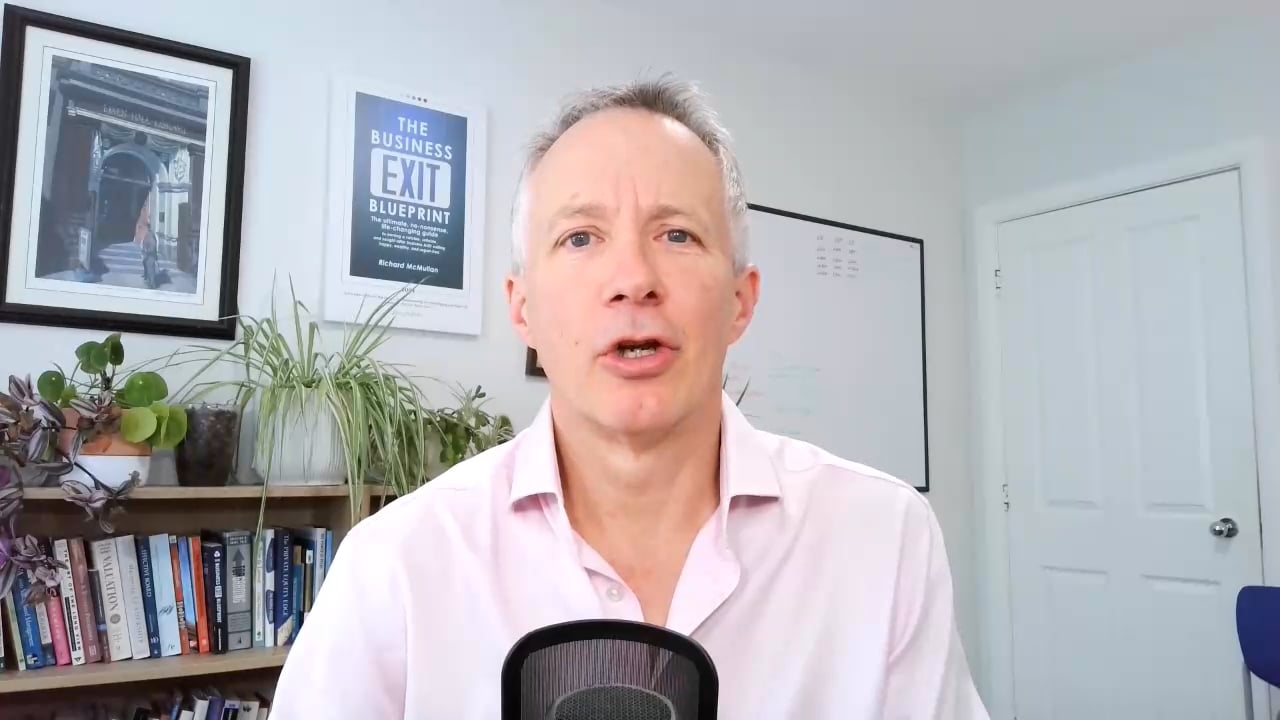
Richard McMullan: Co-Founder, Value Growth Catalyst | CatalystOS™ Creator
I didn’t arrive at my view of business value because it sounded clever or contrarian.
I arrived at it because I got it wrong.
This started with a mistake I didn’t recognise at the time.
Before I ever owned a business, I spent more than a decade in strategy consulting. I understood models, growth plans, market positioning – all the things I thought you needed to know to scale a business well. So when I landed my dream role as Managing Director of a luxury manufacturing business, I was confident I knew what needed to be done.
Nine months later, sales were going nowhere, profits were sliding, and I found myself in the owner’s office offering my resignation.
Instead of accepting it, he told me – calmly and bluntly – where I was going wrong. His point was simple, and it cut straight through what I thought I knew about leadership and performance. That conversation fundamentally changed how I thought about my role, and about what actually drives progress in a business.
What I took from that became the first foundations of what would later turn into CatalystOS™ – though at the time it wasn’t a “system”. It was just a different way of thinking about what really matters.
Over the next six years, I focused relentlessly on those fundamentals. The business grew by more than 50% a year and reached around £16m in sales. We expanded rapidly, opened stores, and did it without borrowing from the bank. On paper, it looked like an unqualified success.
I’ll be honest – vanity crept in.
I wasn’t shouting about it publicly, but internally I felt unstoppable. The business was growing fast, profitable, and increasingly independent of day-to-day owner involvement. It looked exactly like the kind of business most advice tells you to build.
That confidence didn’t survive contact with a buyer.
An old university friend – one of the founders of a highly respected M&A firm – agreed to look at the business and talk through options. I went into that meeting expecting validation. What I got instead was a quiet but devastating correction.
He told me, plainly, that private equity would not be keen to invest.
Not because the business wasn’t performing.
Not because it wasn’t profitable.
But because it wasn’t nearly as valuable or transferable as I believed.
Over the next couple of hours, he walked us through how acquisitions work – how buyers assess risk, dependency, judgement, and future optionality. By the end of the conversation, it was obvious I’d been optimising the wrong things for years.
I’d been focused on the usual metrics: sales, EBITDA, growth, operational performance. What I hadn’t been designing for – or even properly measuring – was value as a buyer would see it.
That was the moment my definition of value started to change.
CatalystOS™ didn’t start as a grand framework. It emerged from that mistake, and from the work of unpicking it. I began to rethink the business not in terms of how well it ran day to day, but how it would be judged later. What a buyer truly valued, what gave them confidence about the future. And how fragile apparently “owner-independent” businesses could still be under scrutiny or change.
When the financial crisis hit and sales dropped by more than 40%, that thinking was tested properly – not in theory, but under unrelenting stress. The business absorbed the shock, stabilised, and rebuilt. Not because people worked harder, but because the structure could cope with a rapidly changing environment.
That experience changed how I think about value permanently.
What I thought was a one-off turned out to be a pattern.
Since then, I’ve seen the same dynamics repeat across different businesses. Over the last decade, I’ve worked directly with more than 135 owners and applied the same thinking inside my own manufacturing businesses. Different sectors. Different sizes. Different stages. The same structural weaknesses showing up again and again.
I’ve seen where delegation genuinely helps – and where it quietly creates new fragility. I’ve seen businesses that are profitable, “professional”, and apparently owner-independent still degrade when conditions change and judgement has nowhere to live except back with the owner. I’ve seen how “best practice” holds up until the fan gets turned on – and what actually matters when it does.
What exists now isn’t a programme, a framework, or a set of tools.
CatalystOS™ is a complete system for running and leading a business that’s designed to preserve and compound value through growth, complexity, and change – not just perform well when things are calm. It treats owner independence as the baseline, not the finish line, and deliberately designs judgement into the structure so it doesn’t sit in one person’s head.
This work only suits the right kind of owner.
This is not for people looking for motivation, reassurance, or someone to tell them they’re doing fine. It’s not about tactics, quick wins, or outsourcing thinking. And it does not suit people who need to be right, protected, or in control of every answer.
It does suit owners who are open, honest, and self-aware. Who can own mistakes without defensiveness. Who are prepared to say “I don’t know” when they don’t know – and stay curious long enough to redesign what needs changing.
A sense of humour helps. So does straight-talking. This work involves confronting some uncomfortable truths about how the business really works and how dependent it still is on you. If everything has to be political or performative, it won’t sit well
That’s also how I work.
I’m direct. I focus on structure rather than symptoms. I sequence value before growth, treat uncertainty as a design input rather than a scenario, and work on the business as a system – not as a collection of isolated problems. The aim isn’t to make things feel lighter for a few months, but to change how the business behaves when pressure hits, so value doesn’t quietly leak away and ownership stops being more demanding than it needs to be.
If you’re here, you’ve probably already sensed that the current way of running your business isn’t sustainable – even if it looks fine on the surface.
The right next step is usually a conversation. Not to sell you anything, but to see whether the way I see the problem fits the reality of your business.
In many cases, it doesn’t. And that’s fine.
But when it does, the work tends to change not just how the business performs – but what owning it actually feels like.
Richard McMullan